
This site is a CV that compiles. Every skill, role, capability and endorsement lives once, in drift-guarded data registries; from that single source the build generates the interactive site, an ATS-ready text CV, JSON, a print-styled PDF and a Word document, in eleven role-focused variants. Accessibility is not a claim on the page, it is a gate on every deploy.
The problem
A working CV is usually three artefacts kept in sync by hand: a website, a PDF for applications, and a LinkedIn profile. Each drifts from the others the moment one is edited, and a two-decade career is a lot of surface area to keep consistent.
Recruiters also want the CV pointed at the role in front of them: a platform brief cares about different work than a product one. Re-emphasising a CV by hand for each application does not scale, and every hand-edit is another chance for the facts to slip.
The approach: a CV that compiles
So the CV is treated as code. Every skill, role, capability, tool, standard, sector and endorsement lives once, as data. The website, the PDF, the Word document and the plain-text CV are all outputs of a build, and tailoring a CV to a brief is a transformation over that data, never a rewrite.
One source of truth
The data lives in drift-guarded registries, so the single source stays single:
- One registry per dimension. Skills, roles, capabilities, tools, standards, sectors and values each live in one registry under src/data. Components read the registries; nothing is hand-typed twice.
- Drift fails the build. A tag used on a role but missing from its registry, or registered but never used, fails a drift test, so the data and the vocabulary that describes it can never quietly disagree.
- Single-sourced everywhere. The same fact never gets a second copy: a case-study screenshot borrows its alt text from the role gallery, the homepage graph computes tenure from real project dates, and the CV variants reorder shared bullets rather than duplicating them.
// From src/data/__tests__/dimensionTags.js, reused across the
// tech / domains / practices / standards dimensions:
it(`every ${field} tag is a canonical registry key (no typos)`, () => {
  experiences.forEach((exp) => {
    if (!Array.isArray(exp[field])) return
    exp[field].forEach((v) => {
      expect(canonical, `#${exp.id} ${exp.company} → "${v}"`).toContain(v)
    })
  })
})
Every format, generated
- One source, five renderings. The build emits the interactive React site, an ATS-ready plain-text CV, a JSON CV, a print-styled PDF and a Word document, all from the same data.
- Tailored, not rewritten. Eleven focus variants (architecture, backend, platform, product, data engineering, full-stack, leadership and more) each lead with the roles and bullets a given brief cares about. Emphasis and ordering change; the facts never do.
- Honest by construction. Because every variant draws on the same registered evidence, no CV can claim a skill the data does not back. Tailoring stays truthful without anyone having to police it.
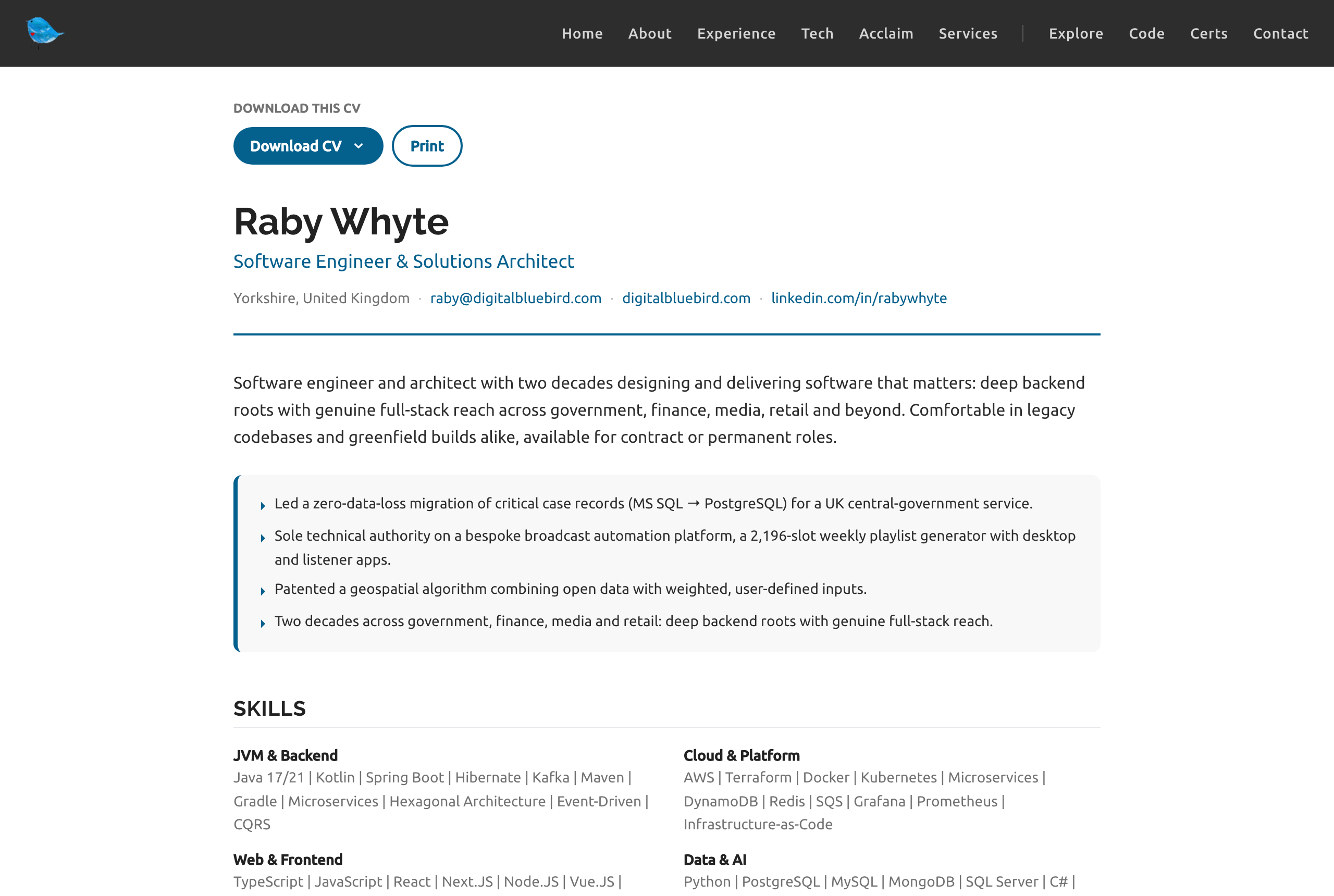
/cv page, one of five formats built from the same data.Explorable, not just readable
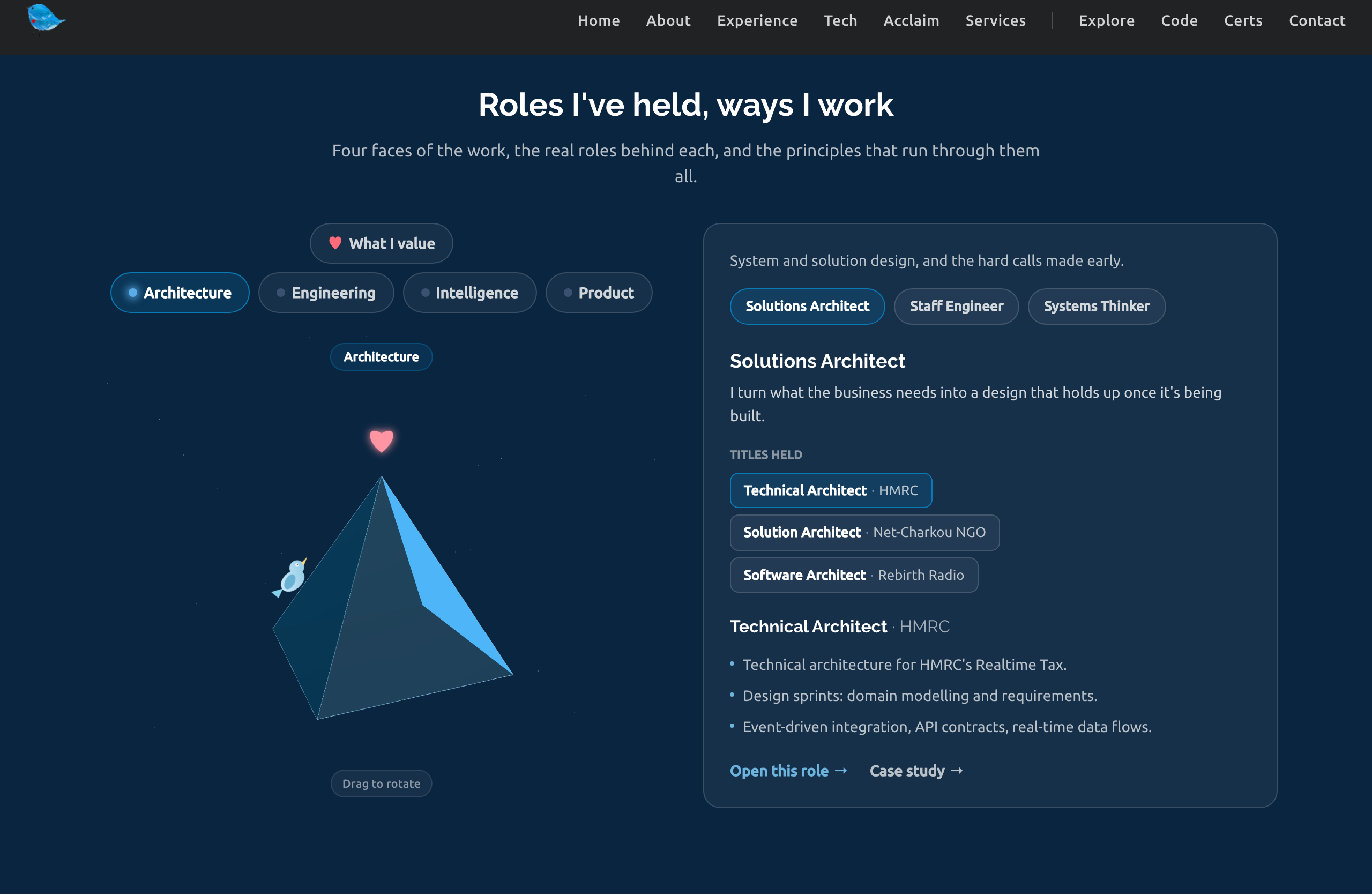
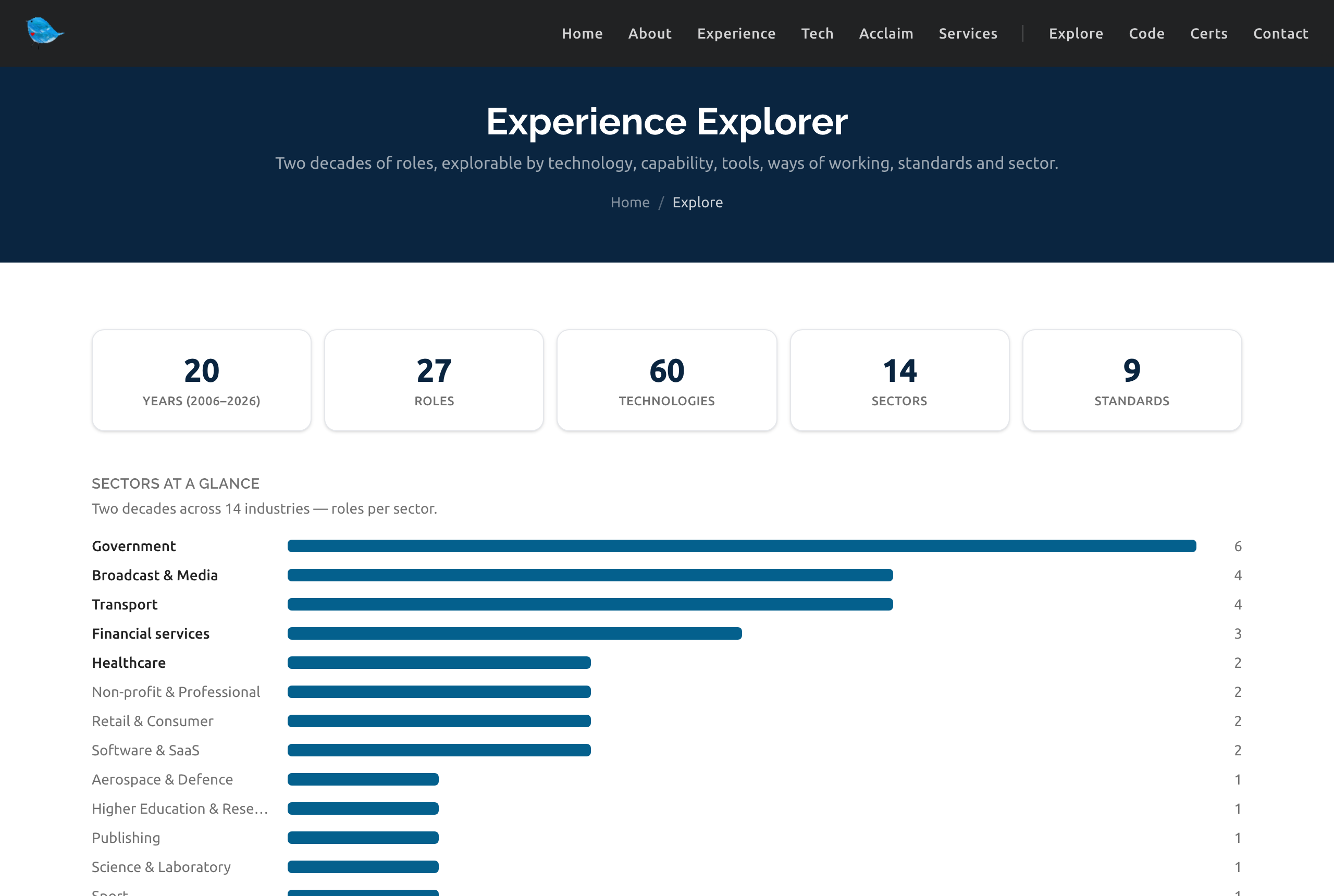
The same data drives more than documents. An Experience Explorer lets a reader filter two decades of roles by technology, capability, tools, ways of working, standards or sector, with the selection held in the URL so any filtered view is shareable. On the homepage, the rotating job titles in the hero are turned into an evidence panel: each is a real title held, backed by the roles behind it. Nothing on the page is hand-typed; it all reads from the same registries.
Accessible by gate, not by aspiration
The footer claims WCAG 2.1 AA, and the build proves it. axe-core runs through Playwright against every key route, on desktop and mobile browsers, asserting zero accessibility violations:
- Unit tests with coverage. Vitest and Testing Library over components, data integrity and the drift guards, held at high coverage.
- End-to-end and accessibility. Playwright drives the real build in real browsers, desktop and mobile, and axe-core asserts zero WCAG 2.1 AA violations on every key route.
- The gate is the deploy. The same unit, build and end-to-end suite runs before every release, so a regression, in behaviour or in accessibility, cannot reach production.
Shipped safely
- A gated, reversible deploy. A single script runs the tests, builds, backs up the live server, rsyncs the new build, and health-checks the result before declaring success.
- Health-checks against the real site. The live main page, SPA routing and every CV download, each with its correct content type, are verified after the sync, not assumed.
- Automatic rollback. If any check fails, the previous backup is restored, so a bad deploy self-heals instead of leaving the site broken.
Trade-offs and what is next
- A prerendered SPA, not a framework. A React single-page app is prerendered at build time into static route pages, a sitemap and Open Graph cards (SVG through satori, rasterised with resvg), giving crawlers and social embeds real HTML without adopting a heavier server framework.
- Deliberately dependency-light. Five runtime dependencies (React, React DOM and the router, plus three.js for the 3D pyramid and ripple for a live demo); everything else, from the CV renderers to the Open Graph generator, is a small owned script rather than a plugin.
- What is next. The data model keeps tightening as the vocabulary grows.