
For most of 2020, one role meant three programmes at once. Senior technical leadership across Channel 4’s All4 streaming platform, the Accenture Innovation Lab, and HMRC’s Real-Time Tax, running in parallel, in three different worlds: a national broadcaster, an internal innovation estate, and a government tax service. Two of the three, Channel 4 and HMRC, have case studies of their own. This one is about holding all three together, and what that asks of a technical leader: moving between a live streaming incident, a cloud bill, and a policy idea being shaped into an architecture, and being senior enough in each that nothing gets dropped in the switch.
Three programmes, at once
The three programmes shared almost nothing but the person steering their technical direction. Channel 4’s All4 was a live consumer streaming service, with category-1 incidents and a national audience. The Innovation Lab was Accenture’s own estate of cloud demos: the software that consultants use to show clients what is possible. HMRC’s Real-Time Tax was a policy idea for the self-employed, still being turned into a buildable architecture. Broadcast, internal innovation and government; a running product, a running cost, and a blank page. The title differed by programme (Senior Technical Lead on one, European Technology and DevOps Lead on another, Technical Architect on the third), but the job was the same: hold the technical direction, and be credible enough in each room to be trusted with it.
Two of the three are told in full elsewhere: the All4 middleware at Channel 4 and the Real-Time Tax architecture at HMRC. What follows is the third programme, the Innovation Lab, and the threads that ran through all of them.
The Innovation Lab: European Technology and DevOps Lead
The Innovation Lab estate was a showcase with a meter running. Its demos had to be live and impressive on demand, so they sat on AWS and Kubernetes infrastructure that cost money whether or not anyone was watching. Managing that estate was the core of the DevOps remit: keeping the demos ready, and keeping the bill for that readiness in view. In a normal year the trade is simple, and availability is worth the spend.
2020 was not a normal year. The consultants who present these demos travel from client to client, and overnight they could not travel at all. An estate provisioned for constant, in-person showcases was suddenly serving a world that had gone still. When the reason for a cost disappears, the cost becomes the thing to look at. The response was cost optimisation tuned to the new reality: pausing and right-sizing the estate, and reworking the AWS and Kubernetes setup so spend tracked actual use rather than a permanent state of readiness. Careful, not blunt, and reversible by design, so any demo could be brought back the moment it was needed. The cloud bill came down significantly.
The role split roughly in half: hands-on engineering, and leading the people doing it. The team spanned a Java, JavaScript/React and Go microservices stack, with Docker and Kubernetes in daily use, alongside the DevOps engineers who kept the estate healthy. Cutting a cloud bill is partly technical and partly a matter of communication: the savings only count once the people holding the budget can see them, which is what the regular cost presentations to executives were for.
HMRC Real-Time Tax: Technical Architect
On HMRC’s Real-Time Tax, the remit was Technical Architect: turning a policy idea for the self-employed into something a team could build. That ran through Design Sprints, stakeholder interviews and requirements analysis, into domain models, systems design and the technical architecture beneath. The proof-of-concept work led directly to new programmes of work, which is the strongest signal a proof of concept can give: it did not just show the idea was possible, it started the programmes that made it real.
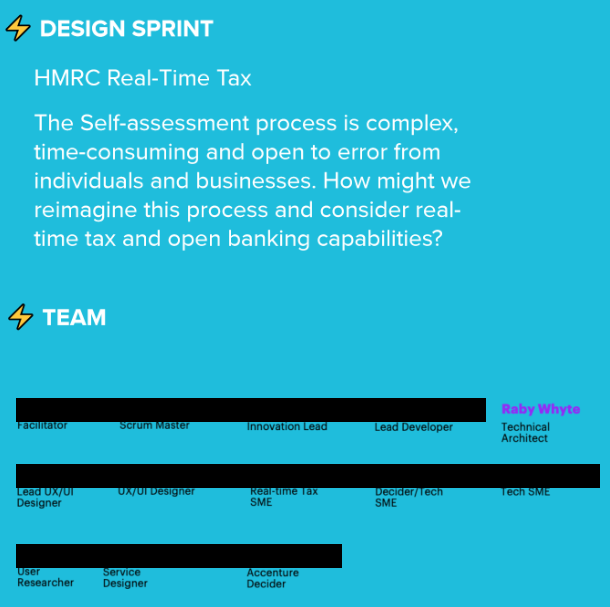
The event-driven design those sprints led to is told in full in the HMRC Real-Time Tax case study.
Held through influence, through a pandemic
Leadership spread this wide runs on more than a title in any one programme. Across broadcast, innovation and government at the same time, technical direction is held as much through credibility as through authority: being the person whose judgement each room defers to, on the merits, programme by programme.
And it all happened in the strangest year to attempt it. March 2020 turned every one of these programmes remote at once, mid-flight, during significant organisational change. PI planning, Scrum team velocity and delivery commitments were kept on track throughout. Alongside the delivery came the enablement: learning sessions to level up the engineers, so the year left the team sharper as well as the estate leaner.
Staff-level scope, before the title
Three programmes, three domains, at once: it is a clear picture of senior technical leadership at staff scope. Depth in each, a hands-on cloud estate on one, an architecture from scratch on another, a national broadcaster’s middleware on the third. Breadth across all three, with the credibility to be trusted with the technical direction of each at the same time, and the judgement to know, programme by programme, where the technical risk actually sat. That is the level this role ran at, in the year it was hardest to run anything at all.